
You’ve planned and prepared material for your small group. You get started and the discussion flows. You have two or three people who are eager to contribute, but the rest of the group isn’t participating much. A few weeks go by and you notice that one or two have found their footing, but you still have a couple of members who don’t say very much. And the doubt has started creeping in: am I really the right person to lead this group?
Understanding the Silence

In today’s world, we’ve become afraid of silence, and above all, we may have started equating silence with failure. But what if the person sitting quietly is simply enjoying being part of a group in a way they’ve never experienced before? What if they’ve finally found their community, but need to crawl before they can walk? Why are we so quick to label silence as failure? Sometimes silence means we’re actually onto something.
That said, silence can of course sometimes mean we need to adjust our approach, but before we get there, we need to first reflect on what silence can also mean. The person may need processing time to work through the question and their thoughts, and just as we move on, they’ve finally found the words. I recognize myself in that, especially when I was younger. Sometimes there may be a fear that the answer isn’t “right,” or that they’ve been shut down before. It might be a new group, or a new person in the group. Maybe they have something they want to say but aren’t sure the group can handle it.
As leaders, we need to try to understand where the silence is coming from, without immediately seeing it as a failure. Instead of being self-critical, we can curiously and gently explore the silence. I could make a list with a thousand possible underlying reasons, and it would still be incomplete. Here are some practical ways to start looking more closely at the silence.
10 Practical Ways to Handle Silence
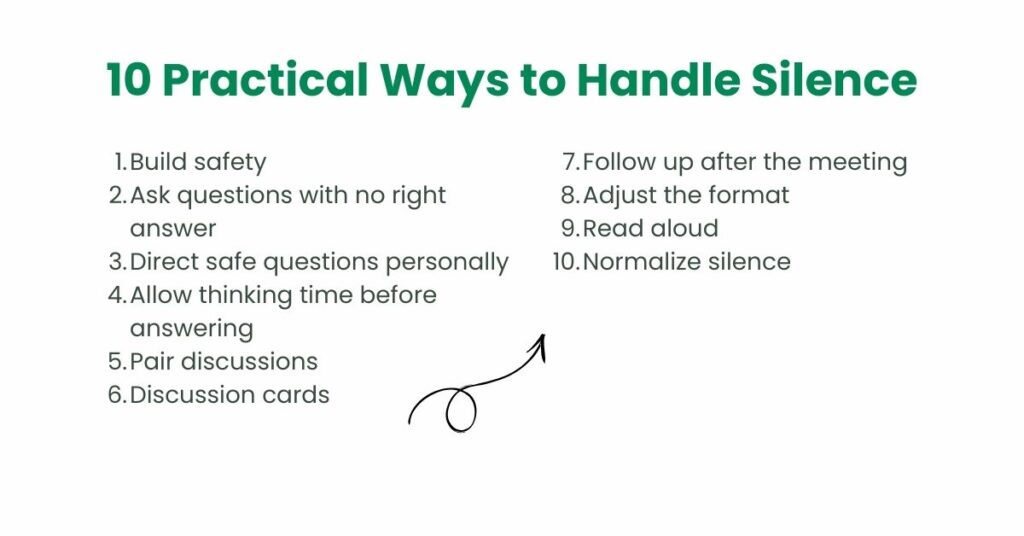
- Build safety
- Ask questions with no right answer
- Direct safe questions personally
- Allow thinking time before answering
- Pair discussions
- Discussion cards
- Follow up after the meeting
- Adjust the format
- Read aloud
- Normalize silence
1. Build Safety
Has your group worked on this? In what ways? A reflection question for you: what can you do at the next meeting to further strengthen the sense of safety in the group, wherever you currently are as a group? Do you need to do an activity together? Icebreakers, however tough we think we are, serve a real purpose. Evaluate honestly whether you think each person feels safe in the group. If not, something needs to change. Celebrate every answer, never correct anyone publicly, and thank those who share something vulnerable.
2. Ask Questions With No Right Answer
Ask open questions that don’t feel like they have “one correct answer.” Try “What stood out to you in this passage?” instead of “What does verse three mean?” Worth noting: for those of us who tend to overthink, almost any question can be turned into one with a right answer. But not everyone thinks that way, so framing questions more openly can genuinely help things move forward.
3. Direct Safe Questions Personally
Direct your questions to a specific person rather than always throwing them open to the group. Both types of questions are valuable and can be included in every small group meeting. Ultimately, we want to reach a point where questions don’t need to be directed, where the environment feels safe enough that people speak up naturally. But to get there, and to remind people that it’s okay to talk, directed questions can be really helpful, especially in the early stages of a group. They also help the people who “don’t want to be a bother” find their voice. “Sarah, I’d love to hear your thoughts on this.”
4. Allow Thinking Time Before Answering
It takes 3–8 seconds for us to formulate our thoughts. Don’t be too quick to conclude that no one has anything to say, give it time. A practical tip: have everyone sit or stand in a circle. Instruct the group that no one should answer immediately, take a moment to think first. When someone has an answer, they give a thumbs up. Only once everyone has had time to think does the discussion begin. Do you throw the question open straight away? Do you go around the circle so everyone gets a turn? You know your group best, but if you do go around, remember point two.
5. Pair Discussions
Before opening up to the full group, have everyone discuss the question in pairs first. Why? The threshold is lower when it’s just two people. It builds a habit of speaking up, and it helps the group’s development by letting people get to know each other a little better.
6. Discussion Cards
Turn your discussion material into cards, with each group member drawing a question. This helps in several ways, it takes some pressure off you as the leader, it means the group can still meet even if you’re unexpectedly unavailable, and it gives quieter members something to “hide behind.” Now they have a reason to speak. But as always, invite, never force.
7. Follow Up After the Meeting
Reach out after the small group with a simple text message: “So glad you were there, I really appreciate you and the role you play in our group. Any thoughts after yesterday?” It doesn’t need to be complicated. But never mention or point out anyone’s silence directly. That will have the opposite effect.
8. Adjust the Format
I have two quirks. One is that I tend to “stare out a window that isn’t there” when I’m thinking or answering a question, say, over coffee with a friend. I’ve since learned that’s connected to my personality type. The other is that I pace in circles when I’m really working through something deep, to my wife’s great delight. She usually looks the other way because my shuffling drives her crazy. Why do I bring this up? Because if your group always sits and talks, there may be people in it who are the complete opposite, people who need to be doing something physical to reach their best insights and conversations. Could you try adjusting the format for your group?
9. Read Aloud
In a bible study group or small group, Scripture is usually part of the meeting. Could you incorporate reading aloud, going around the circle with each person reading a verse until you’ve covered the whole passage or chapter? Just remember: some people may have dyslexia or other reasons that make reading aloud uncomfortable. Always check with the group first, and make clear that “pass” is a perfectly good answer.
10. Normalize Silence
Remind the group that it’s okay to show up however you’re doing that day. Sometimes we arrive completely burnt out, a terrible day at work, a conflict with the kids. Remind them that it’s okay to just be present as they are, and that you’re glad they came. Remind them that it’s also okay to just listen. Knowing there are no expectations can remove the performance pressure that some people quietly carry.
Bible Study Leader Tips: What to Avoid

- Never single anyone out publicly
- Don’t fill the silence too quickly
- Don’t interpret silence as disinterest
- Don’t treat all members the same
Action points
Invite people into your small group and create the conditions for participation, but you can never force it. Always approach silence with care, and don’t automatically assume it’s a failure. Which of these points feels most relevant for you right now, send me your answer or tell a friend? If there’s something you’d like to think through further, feel free to get in touch, and consider subscribing to the newsletter. That way you help me not feel the silence.
And